
How Agni Became Auspicious

The great Rishi Saunak and his students had once gathered at the Naimisharanya at the beginning of the Kali Yuga to save themselves from the effects of this age. Here, Ugrasrava Sauti, the great Sage and son of Sage Lomharshana, came to meet them. He surprised them with stories of King Janamejaya's strange Swarpa Yagna and the strangest tales he heard from Maharshi Krishna Dwaipayana Vyas Dev there, at this strangest of events. The eager Rishis asked Sauti about the story of Bhrigu and Agni.


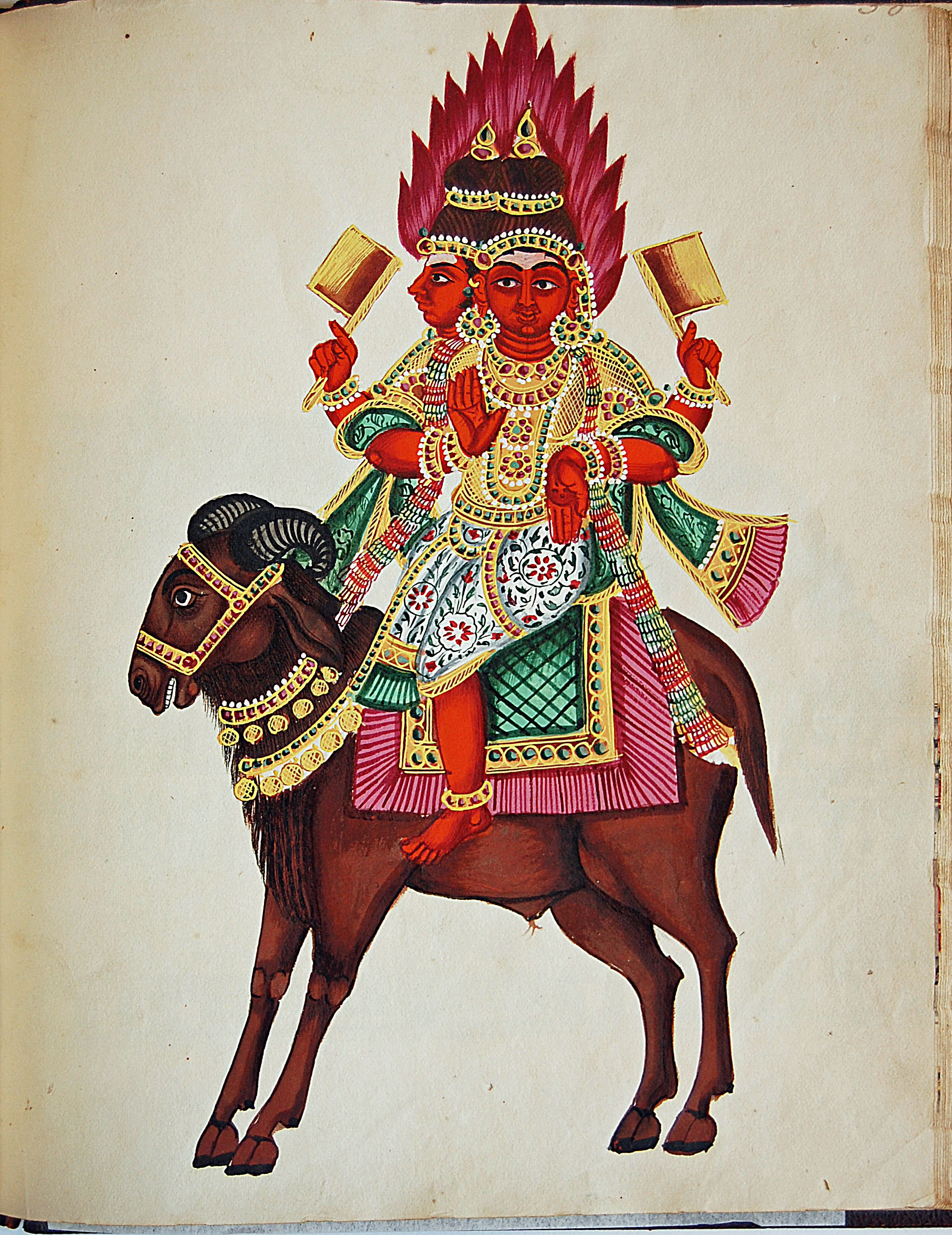
Bhrigu was a powerful Rishi. His wife was Puloma, the Daughter of Daksha Prajapati and granddaughter of Brahma. One day, when his wife was pregnant, he left her in the darkness of the awaiting dawn to go for a dip in the holy Ganges far away. She was alone in the hut when a Rakshasa attacked her. Scared and alone, Puloma cried helplessly for aid. Her beauty had mesmerised the animals who wanted to marry her by force. The demon leader took her into the hut and shut the door. But inside the hut, to her rescue stood Agni Dev. Agni Dev was married to her sister, Swaha. Puloma prayed for his help.
" Let go of the sacred woman, you Demon." Agni roared in anger. Sensing danger, the Rakshas set Puloma free. But he was intelligent.
" Pravu Agni Dev, you are the most truthful in the whole Arya Varta. God, answer my prayers." He pleaded. Agni wanted to hear what this demon had to say.


" Long ago, Puloma was promised to me by her father. Her father proposed marriage, and I accepted it. But then Bhrigu came, and Daksh found him more worthy of her. Without letting me know, her marriage was organised for him. I have searched the lands for her. Tell me, O truthful Lord, does she not belong to me?"

Puloma was shocked at this development, and Agni Dev was in a dilemma. He knew the truth, but saying it would mean Puloma being kidnapped. The demon would probably kill her child, and Bhrigu's anger would destroy the world. Thinking carefully, Agni chose his words wisely, " Rakshas, it is true that you were proposed marriage and she is yours actually, but she was not married to you before marrying Bhrigu Maharishi. She took the Seven Vows with him and hence is his wife legally. Please leave her in peace."

Angered, the demon took a violent shape and scared Agni. He forcefully ran away with Puloma to hide her in a cave. Suddenly, light filled the cave, and Puloma was in deep pain. A beautiful baby boy appeared from her womb. His appearance was godly, his radiance spectacular. The Demon came to kill the child. A scared Puloma wailed. But as soon as the baby boy set his eyes on the demon, the demon turned to ashes. Puloma realised her boy was no ordinary baby; he was God sent to save his mother. Puloma returned with the baby to her hut. 

But guilt filled her heart. Another man had touched her. She feared Bhrigu's anger and rejection. A few hours later, Bhrigu came back and saw a baby on his wife's lap. His happiness knew no bounds as he held his son. But Puloma seemed sad and aloof. After Bhrigu forced her to talk, she cried out, spilling whatever had happened to her while he was gone. Bhrigu got angry and cursed Agni, " You will remain Hungry forever, nothing will satisfy your hunger, and you will destroy forests, villages, animals and birds. They will fear you like a demon."

Chyavana
Agni was surprised and scared. This way, his flames would destroy the world. He went to Brahma and pleaded, " My Lord, I have never lied in my life, yet I suffer this curse. You teach people that lies lead to curses and hell. But if people hear that I got cursed for being truthful, then they will stop speaking the truth, My Lord." Brahma added a boon to Agni's curse. "Your touch will free the soul of sin, it will purify all, and no Puja or Yagna will be complete without it. " Happy, Agni went back to stay on earth. He purified all and helped the Pandavas burn down the Nagas at Khandavprastha. 

Bhrigu understood his son was no ordinary human, meant to be a sage; he went to Narayana for advice. Narayana told him, " Name your son Chyavana. He will be a learned man. He will create a medicine called Chyawanprash, which will be powerful enough to oppose Lord Indra's Vajra. He will create history." Grateful, Bhrigu returned home.


|| Mahabharat Vaani Amrit Saman||
|| Kahe suno Vyas Dev aur Kasiram||


Popular posts from this blog

Maharana Pratap: The Sun of Mewar

Many of you have read my fan fiction as well as historical representations of the life and times of Maharana Pratap Singh of Mewar. I provided small details of his life in many articles. But never have I ever made a separate historical post on him. It is very difficult to put together his life without the help of folklore because historical evidence is scarce. This one was requested, and hence here it goes. Needless to say, this one is very special. This is a blend of history and folklore. Leave your love.  ❤️ Background and Birth: The year was 1540. Mewar was under a cloud of uncertainty. Banbir, their ruler for four years now, was a very incompetent ruler who always spent his time in luxury, drinking and dancing with girls. The crown prince Udai Singh was rumoured to have been killed by him. Chittorgarh was in darkness. Around March 1540, Mewar once again saw hope as some trusted generals, along with Kunwar Udai Singh, attacked Chittorgarh, taking Banbir by surprise. He was soon ...

Bijolia: Her Home

Journey to Bijolia: Lost Kingdoms and Timeless Temples of Mewar Bijoliya translates to a stop between two cities. Nestled in Rajasthan’s Bhilwara district, Bijolia sits 55km from Bundi and 105km from Chittorgarh on the well-travelled Bundi-Chittorgarh road. Once part of Mewar, this seemingly sleepy town guards a rich and layered past: it was ruled from the 11th to the 13th century by the Punwars (or Parmar Rajputs) before falling under the Chauhan dynasty, who shifted the region’s capital to Bhilwara and constructed the imposing fort there. After a brief Chauhan rule, Bijolia was reclaimed by Rana Kumbha and became an integral part of the Mewar kingdom, with the Parmars serving as local Raos, representatives and stewards of the royal house. Despite its history and the famed Bijolia inscriptions (a treasure for historians), Bijolia has never found a seat on Rajasthan’s primary tourist circuit, especially if you’re venturing out by public transport or private car. While a handful of...

The Emperor's First Wife

  Ruqaiya Sultana Begum  was born to Babur's second surviving son, Hindal Mirza, and his wife, Sultanam Begum, in 1542 C.E., merely a few months after Hamida Banu gave birth to the heir Jalaluddin Mohammad Akbar. She was well-versed in Persian, Urdu and Arabic and was attracted to poetry and music. Being a proud descendant of the Timurid clan, most of Rukaiya's childhood was spent in Kabul, near the Bagh E Babur, built by Babur himself. From early childhood, she had seen the struggle of her family to regain their lost power in Hind. In 1551 C.E., just after her father died young at a battle for Humayun, leaving her and her mother in the harem of the emperor, it was Hamida Banu who wanted the marriage of Rukaiya to her first cousin, Akbar. Theirs was the first in-house marriage of the Mughals, soon to be followed by many more in the generations to come. At the mere age of nine, she had married the crown prince, and when Humayun won back Lahore, she was fifteen. At the mere age ...

The Buddhist Empress of India

Many historians believe that although Devi was the first wife of Asoka, his Buddhist queen, Asandhimitra, was not the same person. However, some also theorise based on Buddhist and Jain stories that they were in fact the same person, and the reason for that is that they don't seem to appear in the timeline together. Devi disappears when Asandhimitra arrives at the scene rather abruptly to do her charitable work. Hence, I personally believe they were one and the same. This story, however, is a retelling of folklore and not history. Please do not consider this piece of fiction as history. The whole village of Vidisha Nagari was buzzing with activity. Every home was being cleaned, and cooking preparations were on. The youngest prince of Magadha was coming to a halt the night at their village on his way to Ujjain. Great unrest was reported at Ujjain, and the youngest prince, as the general of this region, was being sent by the emperor to solve the issue. The villagers were scared as th...

Nawab E Bengal

  Background: Nawab Alivardi Khan was ruling Bengal at the peak of Nawabi rule, expanding his strong empire. He had successfully suppressed the Marathas and had given a strong message to the British East India Company’s rising influence at Calcutta. Highly aware of the British Colonial policies across the globe, Nawab Alivardi Khan was strict with his policies and stronghold over Murshidabad, the then capital of Bengal (including present-day Bihar, Jharkhand, West Bengal, Orissa, and Bangladesh).  He had two daughters and no sons. Amina Begum was the elder one, followed by Ghaseti Begum. Amina had three sons with her husband and courtier, Ahmed Khan. The second son, Mirza Mohammad, fondly called Siraj-Ud-Daulah (light of the country)by his grandfather, was born in 1733C.E. He was his grandfather’s  favourite  because he was born while he won over the Marathas. Alivardi Khan never let the “fortune child” of the family out of his sight. Siraj grew up accompanying his g...

Chittorgarh: The First Jauhar

The concept of Jauhar holds a profound place in Rajputana history. It is a ritual where Rajput women willingly choose death by jumping into a fire altar, invoking the gods, and embracing honour rather than living under the humiliation of enemy conquest. Unlike Sati, Jauhar was never forced or compulsory; it was considered the most honourable death a Rajputani could choose when their men lost battles and the enemy laid siege. The Historical Setting: Jauhar Gate and Chittorgarh Fort Chittorgarh Fort once housed the palace of Rana Ratan Singh near the famed Vijay Stambh and his Jal Mahal at the fort’s main gate. When Alauddin Khilji invaded Chittor, much of this was destroyed. However, later ruler Rana Kumbha rebuilt the Jal Mahal and re-established the Jauhar Sthal to honour Queen Padmavati (also known as Padmini). Ratan Singh, who ruled Mewar during Khilji’s reign as Sultan of Delhi, was known to be a peace-loving monarch who enjoyed music and poetry. One of his court poets, Ragha...

Chittorgarh: The Devoted Fort

Chittorgarh, renowned for its tales of sacrifice and valour, is also a remarkable testimony to secular harmony and religious heritage that flourished over centuries. Beyond battles and sieges, the fort and its surroundings are dotted with numerous temples, talabs (reservoirs), kunds (water tanks), and temple complexes;  some intact, others abandoned or in ruins, each narrating stories of devotion, culture, and royal patronage. The Legend of Meera Bai: Devotion and Defiance One of the most inspiring figures linked to Chittorgarh’s spiritual legacy is Meera Bai , the saint poetess and princess of Merta. Married in 1513 AD at age 14 to Maharaj Kumar  Bhoj Raj Singh Sisodiya , the eldest son of Rana Sanga, her story is one of profound devotion. As a child, Meera Bai was deeply attached to the idol of Lord Krishna, whom she considered her true husband, an attachment sparked by a childhood curiosity and nurtured with daily conversations and care for the idol. This devotion dista...

A Journey Called PrAja

Love is a relationship based on trust and understanding.  It is also a bond that is made up there. People often ask, "Why them?" I end up telling them some folklore. I end up telling them about how she actually was his shadow in the forests, in bad times. Because love passes all its tests in the worst times when you don't give up on each other. So, here's to My Pratap and His Ajabdeh! Ps. This is about the show Bharat Ka Veer Putra Maharana Pratap on Sony by Contilloe Starring Faisal Khan, Roshni Walia, Sharad Malhotra and Rachana Parulkar. This is NOT their real story. The show aired from 2013 to 2015. Ajabdeh, the simple, strong yet gentle samantputri, was starstruck seeing the down-to-earth Kunwar Pratap, the crown prince of Mewar. She was clueless that he held the key to her heart, her lost mala that destiny had chosen him for.  Na na na na na Chan Chan Chan Chan na na na na! A comedy of errors followed, as she threw the pail of water on him, fumbled at his presen...

The Annals of Rajputana

Col. James Todd’s Annals and Antiquities of Rajasthan describes Rajputana through History, Geography, Mythology, Folklore, Veer Gathas, Traditions, Cultures, Heritage, Rules, Valour and its people. However, one must remember that he was commissioned to write the narrative and his resources are not based on historical evidence. However, it is worth a read and very interesting. The following excerpts are from his book. Please take note that Todd's accounts are based on hearsay, stories, and commissioned by royals and hence aren't treated as historically accurate. However, his book is important as it is the first English-language book to have extensive work done on Rajputana. Rajputs are commonly believed to be people from Rajasthan; however, their branches have spread far and wide into Punjab, Gujarat, Madhya Pradesh, Bihar, Maharashtra and even parts of Bengal. The initial origination-based clans/tribes had been subdivided first in the book Prithvirajraso by Chand Bardai; howev...

The Reva Cries

Roopmati had watched the troops leave. She had stood behind the chief queen as she traditionally bid goodbye to her sons. She had waited for the Sultan to come to her. He did. He was confident that the sudden advancement of Akbar’s foster brother Adham Khan could be curbed. It was not war, just precaution. He reassured her. Malwa would never bow to the Timurids. And he would not let anything happen to her. To Her. Roopmati felt suffocated by her husband’s affectionate hug. She felt trapped in the scrutinising eyes of all the people in the palace. Angry, blaming eyes. She tried to pace herself and sing, but her voice cracked in fear. Her melody was drowned in tears. Every evening, a messenger would come to the chief queen with the news of war. Roopmati was kept in the darkness. She was not told about anything. She knew the rumours. She was a witch. A temptress who caused doom to the Sultan of Malwa. She was a spy of the enemy planted in his life to destroy him. She wondered if he came b...